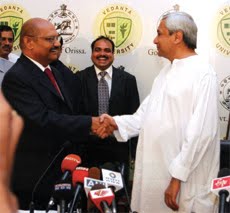
Sunday, August 8, 2010

YFN urges separate law to deal with ‘honour killings’

The following is the text of the key note address by Saswat Panigrahi, national co-convener of Youth for Nation at the talks on ‘Scourge called honour killing’, held in Delhi University on August 07, 2010.

Esteemed speakers, the august gathering and my friends in the media

Youth for Nation(YFN) is an All India organisation having seven chapters across the country. It is a voluntary organisation which creates leadership development programme in the youth. It aims at streamlining nationalism by linking Youth in nation building. YFN is a national movement to arise and awake the youth of our country. It is an initiative to unite the youth across the country on a single platform, where they can share their potentials, exhibit their latent talent and contribute towards nation building. Youth for Nation firmly belives that youth is the most potent catalyst for change. YFN calls upon the youth to take a firm stand on issues affecting our nation.

In pursuit of its commitment towards creating social awareness, Youth for Nation takes great pleasure in organising talks on the ‘Scourge called honour killing’.

‘Honour killings’ are on the rise in India. ‘Honour killings’ target young couples who dare to marry outside their caste or in the same gotra or in the same village or in the neighboring village or in the communities having brotherhood. ‘Honour killings’ are perpetrated under the garb of saving the ‘honour’ of the community, caste, gotra or family. In the name of ‘honour’ young people are brutally lynched to death. On many occasions parents kill and dump the bodies of their children, as they say “for bringing dishonor” to the families. Relatives also join in that shameless attempt to protect the family's so called ‘reputation.’ But whose honour they talk about? Such killings bring dishonor to the nation.

Data on honour killing is disturbing. More than 1,000 young people in India are done to death every year in the name of ‘honour’. Figures show Haryana, Punjab and UP account for about 900 ‘honour killings’ and another 100 to 300 occur in the rest of the country. In the recent past ‘honour killings’ also have been reported in the national Capital.

To tackle the spurt in 'honour killings’, the Supreme Court had sought response from the Union Government and eight States on steps taken to prevent such incidents. Following the directive of the apex court Government has decided to set up a Group of Ministers (GoM) to suggest changes in the law to deal with ‘honour killings.’ But it seems the UPA Government is going slow on bringing a law to rein in such social crimes.

Let’s discuss threadbare the factors responsible for ‘honour killings.’ ‘Honour killing’ is the result of a sick mindset driven by a fixed belief in the interpretations of caste or gotra. In the 21st century when India is positioning itself as an emerging global superpower, confusions over the interpretations of those post-Vedic values in Hindu society seem out of sync.

Youth for Nation believes in the unity of Hindu society and hence sees nothing wrong in inter-caste marriage per se. But all is not well relating to the use and interpretations of gotra in the Hindu society in case of marriage. It is high time to admit that there is a great deal of confusion as the practice varies from place to place. We have gathered here to set the record straight.

So what is gotra? Going by the definition, a gotra is the lineage or clan assigned to a Hindu at birth. In most cases, the lineage is traced through the paternal line. Though people from the same gotra aren't always blood related, as per the traditional matrimonial system, sagotra marriages are not approved as people of the same lineage are considered as siblings.

Scientific evidence seems to suggest that people from the same gotra share historical roots and hence there could be genetic similarities. However, the Hindu Marriage Act, 1955 allows intra-gotra marriages.

Let’s take a look at the regional variations or shall we say distortions in the interpretations of gotra. In some paternal communities where gotra is passed down from father to children, marriage can be solemnised with maternal uncle’s son or daughter, while such marriages are forbidden in matrilineal communities like Malayalam and Tuluvas, where gotra is passed down from mother to children.

Another common practice in south Indian Hindu society is the wedlock between cross-cousins.

The north Indian Hindu society not only follows the gotra norms for marriages, but also has regulations which go beyond its basic definition. There are reportedly (hold your breath) as much as 3000 gotras in North India. In addition to that some communities in North India do not allow marital alliances in the same village, and neighboring villages. Some communities even consider the marriage with some other communities as a taboo on the lines that both the communities are having brotherhood. Some communities also do not allow inter-caste marriages. In north western States of Haryana, Rajasthan and Uttar Pradesh where Khap panchayats thrive in the rural society, the writs are clearly defined. Those who dare to oppose the writ face the wrath, and sometimes a grisly death.

Sarvjatiya Sarvkhap Maha Panchayat -- the umbrella body of Khap panchayats -- demands an amendment in the Hindu Marriage Act seeking a ban on marriages amongst the same gotra as well as people within the same village. Should the permissible limits be relaxed keeping in mind the modern compulsions and the need for social mobility? Does the Hindu Marriage Act need to be amended? Our esteemed speakers on the dias will shed light on that subject.

But I must conclude by saying ‘honour-killing’ is an extreme violation of human rights. Youth for Nation strongly condemns ‘Honour Killings’. As perpetrators get away scot-free on account of legal loopholes YFN urges a separate law to deal with such heinous crime. We are unequivocal in our demand that the existing investigations to all the ‘honour killings’ should be fast tracked and the perpetrators be dealt with in the harshest possible manner.

I therefore request our esteemed speakers to keep their views regarding such an evil social system. Healthy criticisms and comments are welcome.

Thank you.

A brief profile of the speakers

Dr Surendra Kumar Jain: Prof Dr Surendra Kumar Jain is an academic and Hindu right activist. A product of Delhi School of Economics Dr Jain presently works as an Associate Professor of Department of Commerce in Hindu College, Rohtak University.

Prof Jain is the All India Secretary and national spokesperson of Vishva Hindu Parishad. Earlier he worked as the national president of Bajrang Dal. Dr Jain also works as the General Secretary of Arundhati Vashisth Anusandhan Peeth, which carries out research work on nationalistic issues in as much as eighteen universities across the nation. Prof Jain is known for his strong view on hindutva and indianness.

Manoj Raghuvanshi: Manoj Raghuvanshi is a pioneer in the field of broadcast journalism. A practicing television journalist for three decades of experience, as much as 4500 telecasts go his credit. He has anchored and produced several well-known programmes like Newstrack, Aap Ki Adalat, India’s Most Wanted and Javabdehi. Raghuvanshi, a veteran in crime journalism is mostly found to be associated with current and burning issues of present day India.

Prof Avaneesh Awesthi: Prof Dr Avaneesh Awesthi is Associate Professor of English language and literature in Delhi University. A well known commentator in socio politico affairs Prof Awasthy contributes regular columns to major national dailies like Jansatta, Navbharat Times, Dainik Jagran and Rastriya Sahara.

Advocate Prithvi Singh Vatsa: Advocate Prithvi Singh Vatsa is a senior advocate of Supreme Court and Delhi High Court. He taught in Faculty of Law, Delhi University. Mr Vatsa is the national vice president of Bharatiya Kisan Sangh.

Dr Krishna Priya Das: Dr Krishna Priya Das is the Vice President of ISCON, New Delhi and Medical Director of ISCON, India.
Ashima Khanna: Social activist

Chowdhry Ram Charan Solanki: Khap Pachayat sarpanch, Palam gaon, Delhi

Rajvir Ghelot: Khap leader
Moderator: Paritosh Vyas is the National Convener of Youth For Nation. He is an Engineer and management professional. Presently he works as a General Manager with an architectural engineering company in Kolkata. Mr Vyas is the founder of a widely read e-magazine called Rastriya Swabhiman and the owner of an innovative website for blood donation. He was a ‘Lead India’ finalist from Gujurat.

Wednesday, July 7, 2010

Mining a loophole


Saswat Panigrahi

Of the 341 mines existing in Odisha, only 126 operate on the basis of a valid lease. A paragraph in the 53-year-old Mines and Minerals Development and Regulation Act has proved to be the State's bane and the mining companies' boon: It is allowing illegal operators to plunder Odisha to the tune of Rs 3 lakh crore

Mineral-rich Odisha has become a paradise for illegal mining in the last one decade. To earn big bucks, smugglers are making a beeline for the State with the sole aim of plundering its precious minerals. Legal lacunae make illegal mining easy. A sizeable number of mines in the State have been operating years after their leases have expired. The miners use a legal clause involving extension of their leases as an excuse to continue their activity.

Out of 341 mines existing in Odisha, only 126 operate on a valid lease. Of the 215 mines that existed illegally, the leases of 15 expired more than 20 years ago, those of 17 expired 15 to 20 years ago. The lease period of 38 mines ended 10 to 15 years ago and that of another 65 mines ended 10 years ago. The remaining 80 mines have been operating five years after their leases lapsed. This was brought to light by the interim report of the Supreme Court-appointed Central Empowered Committee.

In November 2009, a 150-page petition filed by Mr Rabi Das, senior journalist and president of Odisha Jana Sammilani, brought the mining scam to the notice of the Supreme Court. In response to the petition, the apex court had entrusted the CEC with the task of investigating the scam. The CEC had asked the State Government to furnish all details related to it. The findings of the interim report are based on the submissions made by the Odisha Government and the petitioner.

The 85-page report has laid bare rampant illegal mining making use of lacunae in the Mines and Minerals (Development and Regulation) Act, 1957. As per the ‘deemed extension’ clause under Rule 24A(6) of Mineral Concession Rules 1960, if a lease holder applies for the renewal of mining lease within a stipulated period, the lease is automatically ‘deemed’ to have been extended till the State Government actually deals with the applications.

“A large number of mines are operating in Odisha even after the expiry of the mining lease period. This is being done under the provision of ‘deemed extension’ of mining leases provided under Rule 24A(6) of Mineral Concession Rules and is happening because the applications filed for the renewal of the mining leases remain undecided for a considerable period of time after the expiry of the mining lease period,” the report said, adding: “The deemed extension clause is primarily meant to deal with contingency situations and to ensure that the mining operations do not come to an abrupt end because of administrative delays in deciding renewal applications.”

But the rule has been misused to allow the expired leases to exist for years. “This provision is not meant to be availed of indefinitely. Moreover, continuing mining over a long period of time without renewal of the mining lease becomes a potential source for serious illegalities and irregularities,” the report observed.

Scores of mine owners have excavated iron ore, chromite, manganese and other minerals much beyond the stipulated limit. “The mining activities also exceeded the production limit as approved under the mining plans,” the report said. In Odisha, a good number of mines co-exist with the forest land or reserve forest areas. According to an estimate, as much as 80 per cent of the State’s mineral-rich forest land is being exploited. While carrying out illegal mining, the miners shamelessly flout the Forest Conservation Act and environmental norms.

“Mining activities were going on in a large number of mines in Odisha without requisite approvals under the Forest (Conservation) Act, 1980, environmental clearances, and Air and Water Acts,” the CEC report said, adding, “There was lack of effective coordination and common understanding between the officials of the Mines Department and the Forest Department resulting in ineffective enforcement of statutory provisions.”

The report has suggested a set of recommendations aimed at curbing illegal mining. The CEC has asked the State Government to dispose of the mining lease renewal applications pending for years expeditiously and in a time-bound manner. Deemed extension clauses should only be used in contingency situations and cannot be availed of indefinitely, the CEC said. It also further said that mining in non-forest areas can be allowed only after obtaining environmental and other statutory clearances by the lease-holder. The CEC has decided to charge all illegal miners a one-time fine on a land cost valuation formula. For both renewal of mining lease and mining lease, the lessees would have to pay the net present value of the forests for the entire lease area as per a 2002 Supreme Court directive, the report stated. The fine amount is expected to run into Rs 2,000 crore. But the Odisha mining scam is estimated at Rs 3 lakh crore. The figures tell their own story. The CEC formula does not take into account the millions of tonnes of illegal minerals.

Ever since media coverage of the scam, the BJD Government has been in the dock. Well aware of the large-scale pillage, it turned a blind eye - indeed, let the red-tape allow illegal mining and smuggling, thereby providing covert help to the jholawallah brigade in siphoning off Odisha’s minerals. The image of the Naveen Patnaik-led Odisha Government has been dented. The Odisha Government is trying hard to underplay the scam and sweep it under the carpet. It is reluctant to go for a CBI inquiry into the matter. An indifferent Odisha Government, sitting on the renewal of mining lease applications for years now, is saying it is not at fault as the miners are to blame for not submitting documents, forcing authorities to keep the files on hold.

The Green Bench of the Supreme Court has directed the Odisha Government to implement the recommendations of the Central Empowered Committee with immediate effect. It is now up to the Odisha Government to follow the directive.

-- Appeared in the OpEd page of The Pioneer on July 07, 2010

Also read: Minesgate digs Odisha’s grave

Saturday, June 26, 2010

Does human life mean a little in India?


Saswat Panigrahi

Twenty-five years after lethal Methyl Iso Cyanate (MIC) gas leaked from a Union Carbide plant in Bhopal killed at least 25,000 people, a Bhopal court convicted the company and seven of its officials for criminal negligence and sentenced them for a mere two-year. The accused bailed out in just two hours. "Surely justice... has been done," -- Bhopal gas case judge said talking to media persons.

As rich, elite and powerful are involved in the case there was a deliberate attempt to cover-up. The investigating agencies as well as the prosecutors successfully mishandled the case and distorted the evidence with the clear instructions of those in the corridors of power. And the judiciary acted as a recording machine for those distorted evidence. Moreover, the Indian legal provisions are also inadequately codified to deal with the man-made disaster. Hence the verdict, though a shame is not a surprise at all.

Once the judgment came, skeletons began to tumble out of Congress’ closet, causing acute embarrassment to the party. Evidences are pouring in that former Madhya Pradesh Chief Minister Arjun Singh acted on the directive of Rajiv Gandhi Government at the Centre to ensure a safe passage to former chairman of Union Carbide Warren Anderson in the aftermath of Bhopal gas tragedy.

BR Lall, former Joint Director of CBI, who was in charge of the investigation from April 1994 to July 1995 says CBI was told by the Ministry of External Affairs to go soft on Anderson. Declassified CIA documents of December 8, 1984, a day after Anderson was released after being arrested, shows that the Rajiv Gandhi Government bailed him out. Gordon Streeb, a former US diplomat who was the Deputy Chief of Mission at the American embassy in New Delhi said Anderson was freed as part of agreement then government of India made with its US counterpart. MK Rasgotra, then Foreign Secretary confirmed that Anderson was given a “safe passage” and then Prime Minister Rajiv Gandhi was aware of it. Then Bhopal Collector Moti Singh, has revealed that he was instructed by the then State Chief Secretary to bail out Anderson. December 7, 1984 edition of a US-based newspaper The Pittsburgh Press quoting a release from the Union Carbide saying its chief Warren Anderson was promised by then Indian Government of a safe passage.

After the Bhopal gas case verdict came a shamed Congress government quickly swung into action. A Group of Ministers (GoM) was constituted to examine all issues related to the tragedy, including remedial measures, and make appropriate recommendations on the relief and rehabilitation of the victims and their families. Within two weeks after the GoM constituted, it put together a package of relief, rehabilitation and compensation for the survivors. The rehabilitation package pegs at Rs 982 crore. As things stand, the Indian taxpayer will pay for the pollution of the multinational.

Government now says it will extradite Anderson. But despite the sound and fury, there is there is little hope that India will ever lay its hands on Warren Anderson for alleged culpability in the Bhopal gas tragedy.

Tuesday, June 15, 2010

Waiting for our Messi


With Indian football languishing at the bottom of the FIFA rankings it's time for some soul-searching. So what ails Indian football? Saswat Panigrahi searches for answers

Remember how Mohun Bagan's bare-footed athletic club beat East Yorkshire Regiment in 1911 and became the first Indian football team to lift the IFA shield? During its glory days the Indian football team qualified for the 1950 World Cup in Brazil, but could not be a part of the show-piece event as it was playing bare feet at that time. In the 1951 Asian games in New Delhi and 1962 Asian Games held in Jakarta, team India won gold medals. The success story of Indian football doesn’t end there. India became the first Asian nation to reach the Olympic football semi-final in Melbourne Olympics 1956. Besides, India won bronze in 1970 and silver medal in the 1964 Asian Football Championship. Indian football boasted of football wizards like Gostha Pal, Subimal Chuni Goswami, Sailen Manna, PK Bannerjee, Peter Thangaraj, and Jarnail Singh Dhillon among others that took Indian football to dizzy heights. That was the past. Cut to the present, and Indian football cuts a sorry picture. Indian football fans have to take solace in the glory of adopted teams during the World Cup.

Looking at the nation’s football performance at present, Indian football team’s wining of the Nehru Cup in 2007 at the 13th year of the tournament could be seen as a step in the direction. In 2009 Indian football team again did an encore at the Nehru Cup and added another feather to its cap. Also in 2007 India defeated Tajikistan, lifted the AFC Challenge Cup and qualified for the AFC Asia Cup of 2011 to be held in Qatar.

But where does Indian football team stand vis-à-vis the big boys? The truth is Indian football team has never competed in World Cup. India is ranked a lowly 133rd in the FIFA rankings 2009.

Baichung Bhutia, IM Vijayan, Sunil Chetri, Climax Lawrence, Mahesh Gawli and Shanmugam Venkatesh are the big names in Indian football today. But, they pale in comparison to their illustrious forbears.

At a time when the rest of the world is in the grip of a football mania, Indians will be rooting for either the Brazilians or the Argentinians. Sadly the likes of Baichung Bhutia will wax eloquent on the other teams in the fray, in his avatar as football commentator/ expert. Apart from dissecting performances of the likes of Messi and Ronaldo. The diminutive powerhouse will also display his knowledge of the game, instead of trying to dribble past some of the superstars of the sport. At the same time some football crazy nations will be getting ready to make the cut. But, if someone asks will India ever participate in FIFA World Cup, many will have a hearty laugh.

But, what ails Indian football? Football is played as much in the mind as on the football pitch. It seems our football bosses and players seem to have reconciled to the fact, that we don’t have what it takes.

Despite the game having a presence in the country for more than a century, our players do not possess either the flair, attitude or guts to take on the world’s best. Most Indian players are physically light years behind their European, South American, even Asian counterparts. Low on morale, they do not have the killing instinct to make the cut. Neither do the coaches have the expertise to inspire the players to greater glory.

The All India Football Federation (AIFF), the governing body of football in India is ridden by internal politics. And the Government seems to be least bothered in providing the requisite logistical and infrastructure support to set in place a meaningful football programme. There is no visible comprehensive package to focus on the fitness and tactical dimensions of the players. The scarce funds earmarked for training and development programmes is being misused. The general apathy and absence of a clear vision is proving costly for Indian football as they slide further down the pecking order.

In this cricket crazy country, football is said to be the second most popular sport. Football boasts of a massive fan base across the length and breadth of the country. In states like West Bengal, Goa, Kerala, Manipur, Sikkim and Mizoram cricket could be left behind in the popularity charts. With Indian players conspicuous by their absence in premier football events, it’s time for some soul searching.

If some of the greatest football stars came of the ghettoes of South America and Africa, why can’t Indian football players prove their mettle? Can Indian football reclaim pride of place in the world football? Or could it dream of making it to the top 30 in world order by 2030? Can we ever have our own Ronaldo? To ensure that India takes its first tentative steps in its bid to gain respectability, tough decisions need to be made. The All India Football Federation needs to be recast. It’s time for heads to roll, and accountability to be fixed. Rope in former legends to share their valuable insight, and stop hiring second rate coaches whose footballing careers were shrouded in obscurity. We love our Maradonas and Ronaldoes. Can we have our own? Let Indian football represent hope.


-- Appeared in FIFA World Cup 2010 special coverage of www.dailypioneer.com

Monday, June 7, 2010

Sketching a dynastic siyasat


Saswat Panigrahi
Master storyteller and path-breaking director Prakash Jha knows his subject well. He has mastered the art of putting the subject into the skin of the characters. Jha feels the pulse of contemporary issues and raises them through the medium of cinema.

In Damul Prakash Jha raised caste oppression, in Apaharan he captured Bihar’s kidnapping industry, in Mrityudand he dealt with social and gender inequities and in Gangaajal he captured the pathos of an upright cop trying to deal with a corrupt system. His movie always has a social message. His films rely on solid performances that complement a normally gripping story line.

Jha’s big-budget political thriller Raajneeti which was shot in the Hindi heartbelt hit the silver screen in June. The movie’s plot and central characters are loosely based on great Indian epic Mahabharata in parallels with the American cult classic The Godfather. The film which vividly portrays a modern Indian political dynasty also deals with the interplay between personal aspirations, greed, loyalty and betrayal. It has laid threadbare the ugly underbelly of dynastic politics.

Jha contested the 2002 and 2009 Lok Sabha election from Champaran (Bihar) on a LJP ticket and lost. But he has figured out the political jigsaw and knows its finer nuances. In Raajneeti, on the baground of a modern Indian dynastic politics, Jha has skillfully captured the dynamics of political powerplay -- organisational politics, heat and dust of elections, theatrics on the campaign trail, poll management, how the media is managed in a bid to swing votes in see-saw elections, manipulation in politics, abuse of power and violence in politics. From popular political gestures to pity casting couch, from caste factor to class factor, Jha has played a number of issues to the audience gallery. He has shown a keen understanding over the local lingo (read Hindi belt). The dialogue is replete with expressions and terms that the aam aadmi in general could relate to. Dialogues like -- Raajneeti mein murde kabhi marte nahin, unhe zinda rakhna hota hai taaki jab samay aaye to woh bhi bolein had a pan-Indian appeal.

It was an intelligent script written by Prakash Jha and his co-writer Anjum Rajabali told the viewer with flair. Raajneeti is a story of a cabal of power-mongers indulged in a seamy power struggle. It centers around a powerful political family called ‘Pratap family’ which runs a regional party. When the patriarch of the family suffers a paralytic stroke, the seat of power automatically shifts to his younger brother, much to the discomfort of his son Virendra Pratap (played by Manoj Bajpai) who considers himself as the true inheritor of his father’s legacy. Simmering in the shadow he can’t see his rival cousin Prithvi Pratap (played by Arjun Rampal) rising to power. To play his political card, he sides with a dalit leader called Suraj Kumar (played by Ajay Devgan). Suraj, an ace Kabbadi player, who later emerges as a dalit leader, brought up in a dalit household, happens to be an abandoned child of Prithvi’s mother and an idealist-leftist figure Bhasker Sanyal (played by Naseerudin Shah). The bloody battle for power begins. Prithvi’s younger brother, Samar Pratap, who intrinsically takes interest in politics, working on a PhD in Victorian poetry, setting aside his academic ambitions to teach in New York University steps into the battle following his father’s murder. The simmering volcano called ‘Samar’ erupts, plays a political ace and changes the game of power. His was mama (uncle) Brij Gopal (played by Nana Patekar) to council him in his mission. In the clash for power, Samar’s sweetheart Indu (played by Katrina Kaif) became barter and forced to marry his elder brother Prithvi. The murder of her husband compelled Indu to plunge into the political battlefield and won a mandate on the basis of a sympathy wave.

If one sees Raajneeti as a modern-day Mahabharata, Arjun Rampal has played a Bhim, Manoj Bajpai a Duryodhan, Ranbir Kapoor a Arjun, Ajay Devgan a Karn and Katrina Kaif a Draupadi. Nana Patekar stars as a Krishna. Also Ranbir Kapoor's character is a reminiscent of desi Michael Corleone, the protagonist of The Godfather.

Raajneeti, with a running time of 2 hours and 50 minutes has skillfully handled a powerful storyline and a huge star cast. The turn of events in the movie are rightly linked. Like his previous movies, in Raajniti also Jha successfully put the subject into the skin of the characters with a great accuracy. All actors have delivered their role with great perfection. The performances are strong and credible. For veterans like Nana Patekar and Naseerudin Shah playing serious characters is no difficult task. Nana Patekar was impeccable as he appears in his contemporary style. Naseerudin Shah in a brief role leaves a noteworthy performance. Senior actors Ajay Devgan and Manoj Bajpai have brought back the memories of their incredible performance. But the real surprise came from Arjun Rampal, Ranbir Kapoor and Katrina Kaif, thanks to Prakash Jha. Jha has transformed the three actors and fit into their most challenging roles till date. A handsome Arjun Rampal wears an overwhelming confidence as seen never before. In his first ever such performance, a dashing Ranbir Kapoor fills out his serious character with calm and hence managed to stand out. A sparkling Katrina Kaif draping in saree was carefree as she perfectly plays a serious role.

Raajneeti is certainly the best movie of its genre by far.

Thursday, April 22, 2010

Scam called Vedanta


Saswat Panigrahi

The recent Lok Pal report highlighting gross irregularities committed to favour the Vedanta Group with regard to its ‘world-class’ university project is a strong indictment of the BJD Government in Odisha. It’s time Naveen Patnaik comes clean on the issue

Odisha Chief Minister Naveen Patnaik is in trouble again. This time for the biggest land grab scam in independent India. As much as 6,000 acre of three-crop agricultural land has been allotted by the State Government to the London-based Vedanta foundation, purportedly for establishing a ‘world-class’ university on the Puri-Konark marine drive. The recent order of Odisha Lok Pal Justice PK Patra in response to a petition filed by trade union leader Dwarika Mohan Misra is a strong indictment of the functioning of the State Government. As brought out by the findings of the Lok Pal, the whole idea of Vedanta university was conceived in the Chief Minister’s office.

Mr BK Patnaik, Principal Secretary to the Chief Minister, had initiated a file relating to the establishment of Vedanta university by putting up a note which was signed by the Special Secretary of Finance, the Agriculture Production Commissioner, the Minister for Higher Education, the Minister of Finance and the Chief Minister on July 13, 2006. Just six days after the initiation of the file, a Memorandum of Understanding was signed on July 19, 2006, between the Odisha Government and the Vedanta foundation for the establishment of a ‘multi-disciplinary’ university.

“The MoU in question signed by the parties does not constitute a legally enforceable contract. It appears from the records that the officials of the Government of Odisha had acted in haste to accede to the request of the foundation,” says the Lok Pal in his 26-page order.

The Lok Pal’s findings clearly indicate that 6,000 acre of agricultural land — which includes 1,300 acre of arable land belonging to the Jagannath Temple that farmers linked to the seva of the temple cultivate, and another large stretch of land containing huge quantities of thorium and other rare minerals — is in the process of being acquired by Vedanta Foundation. This violates the Land Acquisition Act, 1894 and the Shri Jagannath Temple Act, 1954, the Lok Pal observes.

There is also a huge chasm between the land required and the land grabbed. The Lok Pal agrees that such a vast track of land would not be required for the establishment of the proposed university, as even world-class universities like Oxford, Cambridge and Harvard are built on lesser land space. This clearly points to an ulterior motive behind the acquisition.

The project will affect at least 50,000 people across 22 maujas (villages) of Puri district who depend primarily on agriculture for their livelihood. Also, the land in question comes under the Costal Regulation Zone and is situated adjacent to the sweet-water zone of Puri district which stands to be adversely affected if the project is operationalised.

It is interesting to note that following the proposal for Vedanta university, the foundation has changed its name thrice. It was originally named Sterlite Foundation but later changed to Vedanta Foundation and then again to Anil Agarwal Foundation. It has been further revealed that Anil Agarwal Foundation is not a public company but a company under Section 25 of the Companies Act, 1956.

The State Law Department clearly stated that the acquisition of land for Vedanta university would require the change of status of the foundation from ‘private company’ to ‘public company’, and only then would it meet the qualification prescribed by the Land Acquisition Act, 1894. “But the views of the Law Department appear to have been misread by the public servants concerned,” the Lok Pal says.

The foundation submitted erroneous documents with regard to the change of its legal status from private to public, and thus, cleverly hoodwinked the core committee comprising senior bureaucrats of the State and influenced them to believe that the Section 25 company had been converted to a ‘public company’. Following this, the core committee rendered all assistance to the foundation even without complying with the statutory requirements.

“From the materials available on record it is clear that the representative of Anil Agarwal Foundation was able to manoeuvre or influence, mislead and misguide senior bureaucrats of the State who had acted without application of mind,” the Lok Pal judgement says, adding, “Steps had been taken in extending the helping hand in haste to Anil Agarwal Foundation in various ways.”

Citing the Supreme Court verdict that says imparting education is essentially charitable in nature and educational institutions should not be established with the motive of earning profits, the Lok Pal has raised a cloud of doubt on the motive of Anil Agarwal Foundation in establishing the proposed international university. The foundation has so far not defined an international university, further putting a question mark on its intention.

The Lok Pal has made a series of recommendations to the Odisha Government on the university project. It has recommended that the Chief Minister consider a moratorium on the project until compliance with the legal provisions for conversion of Anil Agarwal Foundation from a private to public company was met.

It has also asked the State Government to constitute a vigilance cell to monitor the progress of the project and to see to it that the land acquired and delivered to the foundation is done so in phases and not utilised for purposes other than education. Besides, it has directed the State Government to ensure payment of adequate compensation by the foundation to those affected by the project.

Meanwhile, the Lok Pal order has triggered strong reactions from the Opposition. The BJP has rightly raised the issue in the national domain. The party has also demanded the resignation of the Chief Minister on moral grounds.

Shamed by the Lok Pal order and worried over its political ramifications, the Odisha Government has come out with a Press release which says that the media cannot publish the Lok Pal judgement as it has not been tabled in the Odisha Assembly — a logic strongly contested by the BJP which says that it is not the proceeding but the findings which the media should be able to report. The State Government has also written to the Lok Pal’s office, urging the latter to restrain the publication of the report.

-- Appeared in the OpEd page of The Pioneer on April 22

Wednesday, April 14, 2010

Cloud on Vedanta varsity land grant


Saswat Panigrahi I New Delhi

The allotment of 6,000 acres of agricultural land by the Odisha Government to London-based Vedanta Foundation for a proposed ‘world class’ university on the Puri-Konark marine drive has triggered strong reactions from a national convention held under the aegis of the Swadeshi Jagran Manch.

It has been learnt that there is a crude chasm between the land allotted and the land required for the Vedanta university project. Amongst the 6,000 acres of agricultural land, 1,300 acres belong to Lord Jagannath Temple which farmers linked to the seva of the temple cultivate and another large stretch of land contains huge quantity of thorium and other rare earth deposits.

Moreover, the land for which the project was announced comes under the Coastal Regulation Zone (CRZ), situated adjacent to the sweet water zone of Puri which is going to be affected if the project is made operational, experts say.

The proposed university claims to cater to the needs of one lakh students. ‘Secret’ official communication indicates that inside the university campus there are plans to construct a 600-MW power plant, multi-star hotels, shopping malls and airport.

Senior BJP leader Murli Manohar Joshi suspected a huge scam in the project. “The intention of the Vedanta Foundation is not education but pure business. The Foundation has so far not defined the status of international university, which further clarifies its intention. This will be a prodigal paradise for the rich and elite at the cost of agricultural land. The project aims at destruction, not development,” said Joshi. Taking strong cognisance of handing over Jagannath Temple land to the foundation for a throw-away price Joshi said the BJD Government is playing with the sentiments of the Hindus.

BJP Rajya Sabha MP Rudra Narayan Pany said, “The illegal land grab of Vedanta Foundation has a tacit patronage of the Naveen Patnaik Government. Despite being a private company, the Foundation gets all necessary clearance of the State Government to acquire huge quantity of agricultural land, though as per law no private company is qualified to set up a university. In return the BJD 2009 poll campaign was largely funded by Vedanta foundation.”

“This was an erroneous and illegal understanding, indeed an unauthorised transaction derogatory to the interests of Odisha,” quipped Uma Ballav Rath, convener of Vedanta Vishwa Vidyalaya Virodhi Sanghrash Samiti. “It is smuggling in the name of education,” lamented Jayant Das, former Advocate-General, Odisha.

-- The report appeared in The Pioneer on April 14, 2010

Sunday, March 28, 2010

Minesgate digs Odisha’s grave


Precious minerals have been siphoned off with the tacit patronage of those in the corridors of power, giving birth to the biggest scam of independent India, reports Saswat Panigrahi

It is a scam of such magnitude that it will put the likes of Union Minister A Raja and former Jharkhand Chief Minister Madhu Koda to shame. While experts are still working out the final figure, a conservative estimate puts Odisha’s mining scam at Rs 3,00,000 crore. This basically involves millions of tonnes of minerals that have been smuggled out of the mineral-rich Keonjhar-Sundargarh-Mayurbhanj stretch and Jajpur district over the years. Among the State’s rich mineral resources — iron ore, bauxite, chromite, manganese and limestone — iron ore has been clearly the biggest target. Informed sources say the State has produced nearly 420 million tonnes of iron ore worth Rs 84,000 crore but has only earned a paltry sum of Rs 743 crore. The rest is quite obviously unaccounted for. However, the State anti-corruption wing puts that figure at only Rs 409 crore.

The scam first came to light when the ruling BJD MLA Samir Ranjan Das put up a question on the floor of the Assembly about the illegal mining activities of Ram Bahadur Thakur (RBT) Limited. That opened a Pandora's box. Subsequently it came to light that the Odisha Government was in the process of settling a lease in favour of the company last year which no longer exists and was liquidated way back in 1999. In order to obtain a mining lease, the defunct company executed a Power of Attorney (PoA) in favour of Shakti Ranjan Dash who happens to be a close aide of BJD’s Pyarimohan Mohapatra and which probably explains why the State Government had considered the lease application. It has come to light that RBT was mining manganese at Rudukela and Katasahi in Keonjhar district without obtaining a legitimate lease; the manganese mine area was being guarded by none other than the Directorate of Mines.

According to the prescribed rules, a mining company must initially apply for a Prospecting Licence (PL) or a Mining Lease (ML). The applicant has to first clear the mining plan from the Indian Bureau of Mines, submit the forest diversion proposal for the land to be used for mining and provide the compensatory afforestation programme with a deposit of a non-payable amount and a wildlife management plan. Only then does an application get the Union Forests and Environment Ministry’s nod. Once the environmental clearance is granted, the State Pollution Control Board gives the Consent to Operate (CTO) certificate and stipulates the amount of ore that can be extracted in a year. The quantity of ore to be extracted annually is specified in the mining plan which is approved by the Indian Bureau of Mines. The limit is specified with an eye on collateral environmental damage. After an application obtains the statutory clearance of the Union Forests and Environment Ministry and the State Pollution Control Board, the State Mines Department issues a mining lease. The lease deed is then agreed upon by both the lessee and the State Government.

The State Revenue Department demarcates and stipulates the mining area or lease area according to the mining map. The mining area is specified with a central point which is known as the grid point. As per provisions, an allottee can only raise minerals within the allotted area.

However, throwing these existing laws out of the window has now become routine in the State with illegal mining going on rampantly. For the past decade, a well-organised illegal mining mafia has been involved in large-scale smuggling of precious mineral resources from Odisha’s mineral rich districts, bleeding an already impoverished State. A standard operation syndicate usually comprises mine-owners, traders, contractors and criminal gangs who work alongside bureaucrats and unscrupulous officials of the Mining, Forest, Environment, Pollution Control Board, Revenue, Transport and Police departments. This nexus has even reached the corridors of power.

Both genuine lease holders and the mafia are involved. Scores of mine owners have been excavating iron ore, chromite, manganese and other minerals much beyond the stipulated limit. With sophisticated machinery at their disposal, they are able to extract enormous amounts in the least time. In some cases, 800-1000 per cent beyond the permitted limit is mined and the activity even crosses the boundary of the stipulated lease area. Several mine owners even continue mining without renewing their lease. Then there are lease holders who have obtained permits for non-forest land but have brazenly encroached into forest land, including reserve forest areas. There are countless mining plants running without the due environmental clearance. According to an estimate, as much as 80 per cent of the State’s mineral rich forest land is being exploited. The mining mafia, too, operates in a well-organised manner. They largely mine in the forest areas, reserve forest areas, Government mines and unallotted mineral areas. In fact, on many occasions, illegal mining can even be traced to officials of the Mines, Forest, Environment, and Police departments.

Smugglers involved in illegal mining employ both the road and the rail route. The road essentially involves the Kolkata-Mumbai National Highway 6 which goes via Keonjhar and National Highway 215 that connects Panikoili and Rajamunda. Thousands of trucks are engaged in these activities and local criminal networks are actively involved. The weigh bridges and check gates meant for giving clearance to mineral-laden vehicles are inadequately manned. The smuggling is so organised that fake Transit Permits (TP) are regularly printed and used to take away mineral-laden lorries to different destinations. While some are transported within the country, others go to the ports at Paradip, Visakhapatnam and Haldia for export. The rail route is usually used to smuggle minerals to the neighbouring States of Jharkhand, Bihar and West Bengal.

Illegally extracted minerals are usually exported to India’s immediate neighbours. From the transit point at Champua in Keonjhar district the route travels across Bihar’s porous border with Nepal, and from there consignments are sent to China and Bangladesh. The Paradip, Haldia and Visakhapatnam ports are used for smuggling on sea routes. Courtesy the boom in the steel sector in the past decade, there is a huge demand in China. Reports suggest that in 2006-07, 12 million tonnes of iron ore fines was exported to China, Hong Kong and Singapore from Paradip port alone. In 2007-08 the export amount went up to 13 million tonnes and in 2008-09 it crossed 20 million. Similarly, 3.8 million tonnes of iron ore fines from Odisha was exported from Visakhapatnam port in 2007-08, an amount that rose to five million tonnes in 2008-09. The State Government is completely apathetic. A recent “confidential” official communication indicated that 4.5 lakh metric tonnes of iron ore worth Rs 150 crore was smuggled out of Joda in Keonjhar district in January alone. There are big names involved in all this. Among those accused of mining in excess of the permitted limit are the Aditya Birla Group owned Essel Mining and Industries Limited, SR Rungta Group, SL Sarda and ML Sarda with a controlling interest by Jindal Steel and Power Limited, Tata Steel, Sirajuddin and Company, Indrani Patnaik company, IMFA group, apart form Government companies like the Odisha Mining Corporation.

Of all these, RTI documents obtained by Biswajit Mohanty of Transparency International show that the biggest beneficiary is Essel Mining and Industries Limited. Between 2000 and 2006 the company extracted 138,01, 391 mega tones worth Rs 2,555 crore in excess of its stipulated limit from Jiling Langlota Iron and Manganese mines of Keonjhar district. Again, between 2003 and 2006, the company extracted 68,58,460 mega tones valued at Rs 1,714 crore in excess of its stipulated limit from Kasia Iron and Dolomite mines in Keonjhar. The total excess production adds up to almost Rs.4,269 crore.

The SR Rungta group, another baron, exceeded its stipulated limit in a similar fashion. The RTI document, quoting the Ministry of Environment and Forests report dated December 18, 2006, shows that the company mined 92,39,805 mega tonnes worth Rs 1,910 crore in excess of the permitted quantity from six of its mines between 2003 and 2007. It is learnt that the SL Sarda and ML Sarda owned Thakurani B mines in Keonjhar, in which Jindal Steel and Power Limited has a controlling interest, mined iron ore worth Rs 1,850 crore in excess of the stipulated limit. Reports suggest that Tata Steel, which has chromite mines at Sukinda in Jajpur district and iron ore mines at Joda in Keonjhar district, mined ore worth at least Rs 1,700 crore in excess of the permitted limit between 2004 and 2008. Sirajuddin and Company mined iron ore worth Rs 750 crore in excess of its limit from the Belda mines in Keonjhar district between 2000 and 2006. Indrani Patnaik company owned by a member of former Congress Minister Niranjan Patnaik’s family, extracted iron ore and manganese worth at least Rs 132 crore in excess of the permitted quantity in the past decade. The Government-owned Odisha Mining Corporation itself extracted chromite worth at least Rs 100 crore in excess of the permitted limit from its South Kaliapani mines in Jajpur district between 2004 and 2008.

That the Navin Patnaik Government has been aware of this scam has been revealed in documents submitted in the Orissa High Court in connection with the mining scam. A letter written in 2006 by the then transport Commissioner, SB Agnihotri, to about 45 central organisations involved in handling of mineral resources highlights how minerals were being illegally mined and transported. But the BJD Government did nothing to stem the rot. It is now being said that the ruling BJD’s 2009 poll campaign was largely funded by the illegal mining lobby. “A sizeable chunk of black money made from mineral smuggling was gifted to the BJD in the form of a political donation ahead of 2009 polls. To receive those undue benefits, a review meeting was held in Joda of Keonjhar district on January 24, 2009. BJD poll manager Pyarimohan Mohapatra chaired the review meeting of the mine owners and mineral traders. A Deputy Director of Mines also attended the meeting. The Rajya Sabha member’s visit was issued as an official programme by the District Magistrate,” senior Odisha BJP leader Bijoy Mohapatra told The Pioneer.

The mining scam was brought to the Supreme Court’s notice in a 150-page petition filed by Rabi Das, senior journalist and president of Odisha Jana Sammilani. “The organised illegal design injurious to national interests implemented in a systematic way with the active connivance of the State Government has resulted in breakdown of the constitutional machinery. Rule of law has been deliberately subverted by the State Government for unjustly enriching the individual functionaries,” the petition said citing a host of official communication to prove its point.

In response to the petition, the apex court has entrusted the Central Empowered Committee (CEC) to investigate the mining scam. Rattled by the Supreme Court directive, the State Government has ordered suspension of work in at least 200 mines and scrapped 450-odd trading licences. The State Government has set up a task force headed by Chief Secretary Tarun Kanti Mishra and hurriedly engaged the State’s vigilance department for a probe. Meanwhile, sleuths have arrested eight senior Government officials over their alleged involvement in the scam. Eleven cases have been registered against some mining companies. Many heads are still to roll. The Income Tax department has launched nationwide raids on mining plants and mineral export establishments spread across the country. The Director of Mines, Rabindra Narayan Sahu, has been suspended. Steel and mines secretary Ashok Dalawai had to confess before the CEC that there have been irregularities in the mining sector in the past decade.

The BJD Government’s reaction has been knee-jerk. Underplaying the scam, it has only ordered a vigilance inquiry, while the Opposition is demanding a CBI probe. Clearly, going by the reluctance of the State Government to order an honest and transparent probe, there is a lot more to this scam than meets the eye.

-- The investigative report appeared in ‘Assignment’ section of Agenda, Sunday Pioneer on March 28, 2009

Sunday, February 7, 2010

An attack on Indianness


Saswat Panigrahi

In a desperate attempt to woo Marathi manoos, Maharashtra Navnirman Sena (MNS) supremo Raj Thackeray has hurled a veiled threat to separate Maharashtra from the rest of India.

"I don't want to break the country. But if there are demands for a separate nation, politicians who make provocative statements against Marathis will be responsible for it," Raj has said in an oblique reference to a separate country for Marathis.

By threatening to separate Maharashtra from the rest of India Raj Thackrey has raised the specter of a divided India and played a bugle of a war against the nation.

This irresponsible statement of the 41-year old leader, which has threatened the unity and integrity of the nation, is a gross disrespect to the constitution and also an assault to indianness.

Disruption of sovereignty and territorial integrity is a serious offence under the Indian Penal Code. Any conduct which seeks to destroy or damage the unity of the country is punishable under Section 153-A of the Indian Penal Code. Imputations and assertions prejudicial to national integration are punishable under Section 153-B of Indian Penal Code. Why hasn’t Raj Thackrey been punished on the charge of violating the law?

After floating Maharashtra Navnirman Sena, Raj has aggressively projected the ‘sons of the soil’ brand of politics, albeit in a very parochial way, to walk into vacant space of Shiv Sena. And this time he has dared to attack Indian nationhood to promote his parochial interest.

On several occasions Raj Thackeray hit the headlines for his inflammatory remarks themed around language politics and regionalism.

He has accused the migrants from the North Indian States of Uttar Pradesh and Bihar of spoiling Maharashtrian culture. He has called the celebration of holy Chhath Puja by North Indians a "drama" and a "show of arrogance". He has questioned the loyalty of Bollywood legend Amitabh Bachchan towards Mumbai and Maharashtra.

Sporadic incidences of violence against North Indians by MNS workers were reported in Mumbai, Pune, Aurangabad, Beed, Nashik, Amravati, Jalna, and Latur. This has led to the exodus of workers from Maharashtra to their home States, causing an acute labour shortage, ultimately affecting the local industries.

The Congress-NCP coalition which propped up Raj Thackeray against BJP-Shiv Sena combine to win the Maharashtra Assembly election with a comfortable margin has become a mute spectator.

Thursday, November 26, 2009

A year after 26/11


Saswat Panigrahi
It’s been a year. The scars of a 60-hour-long terror seize which scripted a gory tale in blood is very much alive. The fidayeen attacks were coordinated shootings and bombings on multiple targets across India’s financial capital unleashed by Pakistan based jihadi elements.

The attacks took place at Chhatrapati Shivaji Terminus, the Oberoi Trident, the Taj Mahal Palace and Tower, Leopold Cafe, Cama Hospital, Nariman House, Metro Cinema and a lane behind the Times of India building and St. Xavier's College. There was also an explosion at Mazagaon, in Mumbai's port area, and another in a taxi at Vile Parle.

The unprecedented terror strikes, which shook India and startled the world, started on November 26 2008 and ended on November 29, 2008, snuffed out the lives of at least 166 innocent people and wounded more then 300. Among the dead were 136 Indians and 28 foreign nationals from 10 countries.

Mumbai police, Rapid Action Force personnel, Marine commandos and National Security Guards commandos performed with remarkable bravery and professionalism in their battle with the terrorists. 15 policemen and two NSG commandos sacrificed their lives in the counter-offensive. Assistant Police Sub-Inspector Tukaram Omble, who succeeded in capturing a terrorist alive, Mumbai Anti-Terrorism Squad (ATS) Chief Hemant Karkare, Additional Commissioner of Police Ashok Kamte, Encounter Specialist Vijay Salaskar, Senior Inspector Shashank Shinde were among the 15 policemen killed in the operation. NSG Commandos Major Sandeep Unnikrishnan, Hawaldar Gajendra Singh were also killed during the counter-offensive.

What may be the most well-documented terror strikes of the recent times, the attacks which were carried out by ten trained Pakistani young jihadis, were meticulously planned several months ahead of time. The attacks were executed by the Lashkar-e-Taiba (LeT) inside Pakistan. Reports say former officials from the Pakistani Army and its ace intelligence service Inter-Services Intelligence (ISI) helped training the Mumbai attackers. The sophistication in the design of the terror strike also clearly points to an official backing from Pakistani agencies. However, a possible involvement of local elements in the role of facilitators can’t be ruled out.

Indian investigations reveal that the ten jihadis, who traveled to Mumbai from Karachi via Porbandar across the Arabian Sea, hijacked Indian fishing trawler 'Kuber', killed the crew and entered Mumbai on a rubber dinghy. They have a detailed lay out plans of their targets. To navigate to Mumbai by sea and to find their targets, the terrorists used Global Positioning System handsets. They also used Google Earth to familiarise themselves with the locations of their targets. Moreover, the attackers were constantly directed by handlers from inside Pakistan via mobile phones and Voice over Internet Protocol.

The investigation further reveals that each jihadi carried a dozen hand grenades, a 9 mm handgun with two 18-round clips and an AK-47, seven to nine 30-round magazines and more than 100 rounds of loose ammunition. Each attacker also carried a 17.6-pound (8 kg) bomb. Type 86 Grenades made by China's state-owned Norinco were used in the attacks.

Reports say the terrorists used at least three SIM cards purchased on the Indian side of the border with Bangladesh, pointing to a local involvement. Reports further suggest that one SIM card was purchased in New Jersey, US.

Blood tests of the jihadis indicate that they had taken cocaine, Lysergic Acid Diethylamide drugs and steroids during the attacks to sustain their energy for long hours.

Investigations revealed that the attackers were in their twenties. Nine of the ten attackers were from the Pakistan’s Punjab province, one was from the North-West Frontier Province of Pakistan. Nine of the ten gunmen were shot dead during the counter offensive by security forces and Ajmal Amir Kasab, the lone terrorist, who was captured alive, is now facing the trail.

After a series of denials to India’s dossier on Mumabi attacks, Pakistan which continues to be a safe heaven for terrorists buckled under tremendous international pressure. Pakistani Interior Minister Rehman Malik finally agreed that "some part of the conspiracy" did take place in Pakistan and promised to bring the perpetrators of the Mumbai attacks to justice.

The Pakistani authorities have also admitted to their Indian counterparts that the LeT plotted and financed the attacks. Pakistani investigations conducted on LeT camps in Karachi and Thatta revealed diaries, training manuals, maps of India and operational instructions relating to 26/11. "The investigation has established beyond any reasonable doubt that the defunct LeT activists conspired, abetted, planned, financed and established [the] communication network to carry out terror attacks in Mumbai," said a report from Pakistani investigators to Indian authorities.

However, Pakistan which is not abandoning its policy on supporting terror groups, has come up short of Hafiz Saeed, the founder of Lashkar-e-Taiba, believed to be the mastermind of terrorist siege of Mumbai. Saeed, against whom an international arrest warrant was issued by Interpol, was freed by a Pakistani court from detention on the ground that the Pakistani Government did not have enough evidence against him, outlining Islamabad's lack of seriousness in its ‘commitment’ to bring the perpetrators of the carnage to justice.

But an ‘under-the-table’ diplomacy of the Congress-led UPA Government has failed to bend Pakistan. Moreover, it had shocked the nation by delinking terrorism from composite dialogue in the Sharm el-Sheikh Indo-Pak joint statement, issued by Prime Minister Manmohan Singh and his Pakistani counterpart Yousuf Raza Gilani in July last, replicating a Charles De Gaulle line. It is to recall that after 26/11, Prime Minister Manmohan Singh had categorically stated that there was no question of holding dialogue with Pakistan unless it gives enough proof of taking action against its nationals who masterminded Mumbai attacks, and initiate steps to dismantle the terror infrastructure on its soil.

In the recent months disclose, David Coleman Headley, an American citizen of Pakistani origin, his associate Tahawwur Rana, another Pakistani origin Canadian citizen, both currently in FBI custody in the US are believed to have played a key role in the Mumbai attacks and were also plotting similar terror strikes in strategic locations of the country including the prestigious National Defence College in New Delhi. There are reports which also suggest Headley’s link to Bollywood. Reports also indicate that the notorious Pakistani intelligence agency ISI could be linked to Headley. Meanwhile, an official inquiry in New Delhi has revealed that the Consulate General of India in Chicago had issued multiple entry visas to Rana and his wife under the ‘discretionary quota’ in October 2008, outlining a major security lapse.

On the eve of the first anniversary of 26/11, a Pakistani anti-terror court has indicted LeT's operations commander Zakiur Rehman Lakhvi and six others for involvement in the Mumbai attacks and declared 16 people, including Ajmal Amir Kasab, as proclaimed offenders. In a related development, Pakistan has also confirmed that a retired army major had been arrested for his alleged links with Headley and Rana.

At a time the country is paying tribute to the heroes and victims of Mumbai terror attacks, let’s discuss the naked truth. 26/11 has laid thread bare an abysmal intelligence and a spineless security, which helped the terror seize to succeed. Further, there are questions which will continue to haunt the Government. How bullets traversed through the bullet-proof jacket of three top Mumbai cops ATS Chief Hemant Karkare, ACP Ashok Kamte, Encounter Specialist Vijay Salaskar? Karkare’s bullet-proof jacket is reportedly goes missing, so as the file on the procurement of those jackets. An inept RR Patil, ‘famous’ for his utterly ridicules remark right after the terror seize -- “Bade shehron mein aisi choti baatein hoti rehti hai” -- got back to his old portfolio of Maharashtra Home Minister. Reports suggest that the cost of keeping the lone gun man Kasab alive is as much as Rs 31 crore and counting. A year after 26/11 when PM Manmohan Singh is having a ‘lavish and extravagant’ dinner at the White House, rehabilitation still elude more then two-thirds of the victims and their families.

Rightly says, Army Chief Gen Deepak Kapoor, "The US has not allowed a second 9/11 to happen, Indonesia has not allowed a second Bali-bombing to happen. India has allowed people to get away after the Parliament attack, Delhi blasts and finally the 26/11 incident. The time for all of us has come to say no more.”

However, in the larger reckoning, the problem remains. India is being systematically targeted by jihadi elements. One year on, is India alert and prepared to thrwart future terror attacks?

Monday, November 9, 2009

Looking back at Kandhamal


Saswat Panigrahi

A year after Kandha tribals erupted in fury, the real issues behind the conflict remain unaddressed. An indifferent Orissa Government refuses to recognise the reality

One year on, the agony of Kandhamal is refusing to simmer down. At a time when Kandhamal’s real problems are being disregarded and there is a deliberate miscalculation in handling the crisis by secular fundamentalist media and political parties which pin blame on ‘Hindu groups’, comes a report which not only exposes the allegations against the much-touted ‘Hindu hand’ but also depicts the authentic source of tribal anger.

The report, titled Kandhamal: A Fact File by Michael Parker, published by India Foundation, reveals that the violent upheaval in Kandhamal is rooted in its socio-demographic history. Parker is a Washington based researcher of ancient indigenous cultures of the world and their role in a globalised society. “A social chaos, similar to that experienced by American tribes threatened the cultural stability of the entire region,” the report says.

Kandhamal has two distinct inhabitants -- the tribal Kandhas and the Schedule Caste Panas - their relations have a history of turbulence and the report has brought its genesis. It was during the British period the Panas made a ‘momentous choice’ of coming closer to the Christian missionary and eventually converted to the Christianity. However, for Kandhas, Christianity was closely identified with the British colonial powers that they have battled in at least eight different wars.

The problem arises, says the report, when Christian Panas are unwilling to forgo the benefits of being a member of Scheduled Caste. “Not only have the Christian Panas obscured their religious identities as Christians, they have submitted fake certificates identifying themselves as members of the Kandha tribal community,” the report says. These certificates are used to usurp land, Govt jobs and academic opportunities reserved for the Kandhas. Alienation of tribal land is the foundation of the Kandha-Pana turmoil. “Kandhas were blatantly disinherited from their lands for generations,” the report says adding, “Another major complication related to the land issue is that posed by Christians use of encroached lands to build churches.” Despite Indian law prohibits sale of tribal land to non-tribals, Odisha Government official report says 52 per cent of Kandhas own less than 10 per sent of the land in the district.

“Adding yet another layer of turmoil to the situation, the Christian Panas began a movement demanding official recognition as a Schedule Tribe,” the report says on Kui controversy. Kui is the native language of Kandhas. The amended central Scheduled Tribe list included the ‘Kui community’ in the ST category. Parker report quotes two schools of thoughts in dealing with the controversy. A section of experts on tribal affairs says Kui means Kandha and there is no need to add Kui in the Central Scheduled Tribe list, where as another section says the word Kui is used not in terms of language but in reference to a tribe.

“The records and the facts prove that Panas are not and have never been a tribe in accordance to the guidelines set by the Indian Constitution,” Parker says.

“Thus the Kandhas are understandably in an uproar over the loss of opportunity. A system that was designed to alleviate their poverty and social stagnation has been hijacked and their woes compounded,” the report states. “The dire consequences of a trauma denied and unresolved are always sudden and explosives…It is obvious that it is a primary cause of the turmoil at the heart of Kandhamal’s crisis,” it observes.

Another ominous side of Kandha-Pana divide, as brought out by the report is the shadow of the Maoists in the region, who take advantage of the situation. “The tension between the Christian Panas and Kandhas is so tangible that it has been identified as a strategic opportunity for the Maoists,” the report says. It further adds, “The enmity between the Maoists and Kandhas (after Kandha’s 2002 declaration of war against Maoists) created the dynamic for a Maoist-Christian Pana alliance.” This provides the Maoists a reliable source of recruits. And from the Christian Pana perspective the Maoists became a powerful weapon to use against the Kandhas.

The report has taken note of foreign sources of funding which continue to pour into Christian coffers. The Odisha Government record says an amount of Rs 4,215, 585,000 (approximately $100 million) of foreign funds went to such groups from 1999 to 2003 which are allegedly being used to convert people away from their native faiths.

The report quoted the documental evidence of the murder conspiracy of Swami Laxmanananda Saraswati, who fought against fraudulent conversion and cow-slaughter, by the evangelists, uncovered by Ashok Sahu, senior Odisha BJP leader and former Assam ADGP.

“He was attacked on multiple occasions and it was a common knowledge that every attack had been at the hands of the Christian extremist,” the report says, adding “The Swami appears to have been killed by a conspiratorial alliance of Pana Christians and Maoists.”

The Congress-led UPA did not pay heed to the request of Odisha Government to control the violence that followed the Swami’s killing, the report says. “As violence swept across Kandhamal the Government of Odisha issued an official request for assistance from the Central Government of India. The Congress controlled UPA Government refused to cooperate. The State of Odisha was subsequently obliged to file a petition with the Courts. Only after the judicial branch ordered the Central Government to provide assistance, were peacekeeping forces sent and funds allocated towards the State’s request,” it says.

The report has also brought out the State of Odisha’s miscalculation in handling the emergency that followed the violence in which both Kandhas and Panas were affected. “As Pana Christians sat cozily in relief camps getting food, medicine and shelter, the Kandha had no refuge or food,” it says. Deprived of the relief the Kandhas took shelter in jungle. “Kandhas were arrested arbitrarily. Daily labourers and wage earners remained hungry and tribal women rallied for relief….Night raids and arrests on trumped up charges based solely on Christian Pana complaints combined with allegations of sexual harassment of Kandha women, theft, raids on livestock and food by CRPF troops had the Kandhas up in arms,” the report adds.

Further, the report has brought out the Kandhamal nun rape accusation and media’s ‘carte blanche’ acceptance while promoting the allegations as proven facts. Parker has raised some moot questions in his report that suggest that the claims of the nun were in a constant state of flux. In her initial complaint the nun did not mention the rape, but it was added to her testimony a full 24 hours later. Forensic evidence revealed that the nun was sexually active, no vaginal injuries signifying rape was found yet semen was recovered and no evidence of rape was found upon the clothes of the nun in the tests conducted by Odisha State Forensic Science Lab.

“The media, rather than relying in facts, went overboard in misinterpreting the case and the creation of an alternative reality that fit their pre conceived agendas,” Parker says.

India has survived repeated onslaughts of foreign forces. Kandhamal is an example. There was an international conspiracy to defame Odisha and India. In Parker’s word, “Various Leftists commentators, empowered by the Globalist-controlled media outlets added their illogical rationales to India’s anti-indigenous combine. It has been suggested that some among these powers have a definite role to play in the Kandhamal violence.” Time will reveal the conspiratorial roles in Kandhamal mayhem.

-- This is an extended version of the article published in the Op-Ed page of The Pioneer on November 9, 2009

Also read:

Sunday, October 25, 2009

A victory by default


Saswat Panigrahi

In a pleasant surprise to the Congress-NCP combine, the ruling alliance has managed to win 145 of the 288 assembly seats in the Maharashtra Assembly election and returned to power for the third successive term. The opposition Shiv Sena-BJP combine saw its worst-ever performance in two decades with its tally reduced to a double digit, a mere 90 seats.

If Congress claims, the victory in Maharashtra is performance driven, it is sadly mistaken. The stark reality is that Congress-NCP combine has won not on the basis of performance, but on the basis of factionalism.

Maharashtra Navnirman Sena (MNS) supremo Raj Thackeray has reasons to smile. Wining 13 seats may sound small in a House of 288, but this has led a three-and-a-half-year old MNS to make an inroad into Marathi manoos by successfully cutting into the Sena-BJP alliance votes in its maiden assembly poll foray. Piggy riding on this ‘crucial’ MNS factor the Congress-NCP alliance has bucked a severe anti-incumbency.

The MNS, which contested 143 seats and lost its deposit in 95 of them, has managed to secure a six per cent of vote share. In Mumbai-Thane-Pune stretch, which happens to be the traditional catchment area for BJP-Shiv Sena alliance, MNS’s vote-share is as high as 20 per cent. In Mumbai, MNS has secured a 24 per cent votes, leaving the Sena behind at 18 per cent.

In the country’s financial capital, the MNS won six seats, the second highest after the Congress, which won 17 seats, where as Shiv Sena-BJP alliance together won eight seats down from 13 in the 2004 Assembly poll. The MNS has won three seats in Nashik, two in Thane and one each in Pune and Aurangabad districts. It is pertinent to mention here that the MNS has mauled Sena in its traditional bastion of Lalbaug, Parel Dadar and Mahim (known as Sewri and Mahim after delimitation). This implies Raj Thackeray has skillfully targeted the urban cluster as an investment for his future.

Besides, the MNS has hit the saffron alliance in at least 40 seats across Maharashtra that invariably added to the Congress-NCP kitty. The MNS has not only dented Sena’s vote bank, but also the vote share of NCP in some places as well.

The 41-year old firebrand Raj Thakrey was once considered as the true inheritor of his uncle Balasaheb’s ‘Sainik legacy’. For a long time he headed the Sena’s student wing Bharatiya Vidyathi Sena and carved a fan following. After floating Maharashtra Navnirman Sena, he has aggressively projected the ‘sons of the soil’ brand of politics, albeit in a very parochial way, to walk into vacant space of Shiv Sena. He has appealed to the core instincts of the Shiv Sena far more effectively than Uddhav Thackery has managed to do. This has really worked. The three-and-a-half-year party has diminished an aura surrounding a four-decade-old Shiv Sena. A good number of Maharashtrians known for their loyalty to the Sena switched sides and flocked to MNS flag.

A sharp decline in BJP-Shiv Sena’s tally on the face of an undercurrent of the MNS wave has surprised many. BJP’s tally has been reduced to 46 seats down from 56 and that of Shiv Sena to 44 down from 62 in 2004 Assembly election. But, the ‘crucial’ MNS factor is not entirely responsible for the decline in BJP-Sena showing.

At a time Shiv Sena’s ‘Son’s of soil theory’ was hijacked by the MNS, caught in the vortex of regional demands and its national presence was the BJP. The Sena-BJP combine failed to seize the moment and could not forcefully raise the issues which are plaguing Maharashtra -- unabated farmers suicides, acute power shortage, price rise, infrastructural bottlenecks -- which could have put the ruling alliance on mat. The saffron alliance failed to read the popular pulse and was unable to reach the voters with a message that the decade old Congress-NCP regime had miserable failed to address the gap between Maharashtra’s potential and performance. Perhaps because of its lack of assertiveness to raise the real issues, the Maharashtrians have not taken seriously a ‘people’s centric’ manifesto of BJP-Shiv Sena combine which has sketched a blueprint for development in areas of education, employment, agriculture, rehabilitation, security and infrastructure. In such a political jigsaw the NCP-Congress alliance romped home in the poll by default.

The assembly election result has thrown yet another surprise. The BJP has performed unexpectedly poorly in its own stronghold of Vidarbha region, where Congress has been emerged as the largest party, wining 24 of 62 seats of the region. Interestingly, in Yavatmal district of the region, which is known as the epicenter of famers suicide the Congress-NCP has also performed well. The BJP is yet to figure out what went wrong.

Shiv Sena citadels have crumbled under Raj Thackrey's assault. The poor performance of Sena has put a question mark on Uddhav Thackery's leadership style. The result could trigger a drift by the Shiv Sainiks towards MNS. For the BJP which is struggling to come out of the turmoil following its shocking defeat in the 2009 general election, the result has further dampen its morale.